Tag Archive for: saving lives

An infographic made of a large purple circle with the number 1080 in the center of the circle.

Honoring the gift of life: Midwest Transplant Network saved lives through 1,080 organ transplants in 2025

Midwest Transplant Network is proud to share a level of achievement for transplanting lifesaving organs.

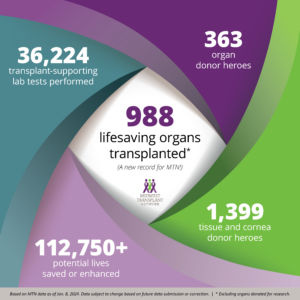
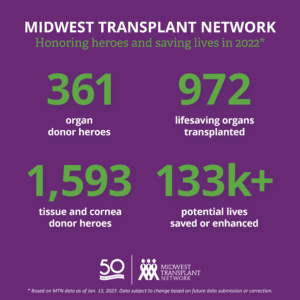
In 2025, MTN honored the legacies of 371 donor heroes through their gifts of donation and provided 1,080 organs for transplant.

In 2024, MTN transplanted 1,075 organs from 399 donor heroes. It was the first time MTN reached and surpassed one thousand organ transplants in a single year.

Midwest Transplant Network is a not-for-profit organ procurement organization (OPO) and consistently performs in the top 10% among 55 OPOs in the country, according to data measures by the Centers for Medicare and Medicaid Services.

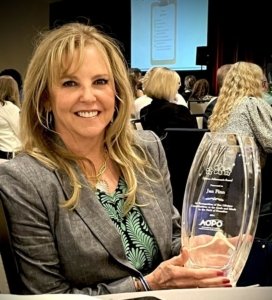
“We are truly grateful to the donor heroes and their families for giving these gifts to save lives and help so many people. This is only possible because of the generosity of donor heroes, and the commitment of our staff and hospital partners to honor their gifts with dignity and compassion,” said Jan Finn, RN, MSN, President & CEO, Midwest Transplant Network.

“The impact of donation means lives are changed in ways that truly make a difference. Because of the meaningful work we do, it means the grandmother who needed a kidney gets to see her grandchildren grow up. It’s the husband who waited for weeks in the hospital for a heart transplant and he’s healthy enough to ride bikes and take trips with his wife and sons. It’s the young woman who had a second liver transplant that brought her back to health, so much so that she’s in nursing school to become a transplant nurse.

“We want the donor families to feel honored and respected for their part of the donation journey. And we want the transplant recipients to know we are working for them, too.  It’s these reasons this work is so meaningful,” said Finn.


2025 – Honoring the gift of life

One organ donor can save eight lives; a tissue donor can enhance 100 lives. Through MTN, organ, eye and tissue donor heroes and their families saved and enhanced lives:

  • 371 donor heroes shared the gift of life, resulting in 1,080* lifesaving organ transplants.
    (*Excluding organs donated for research)
  • 1,682 cornea and tissue donor heroes saved and enhanced lives.
  • MTN’s award-winning histocompatibility lab performed 39,122 transplant-supporting tests including bone marrow matching and analysis to evaluate the effectiveness of transplants.
  • MTN marked its third full year of the onsite Donor Care and Surgical Recovery Unit (DCU), caring for 90 donor hero patients resulting in 345 lifesaving transplants.


At a Glance

An infographic of purple, green and blue circles with end-of-year data numbers connected by a wavy gray line.

MTN Year-End Numbers for 2025


More lives to save

Organ transplants save lives every day, yet data reports from Health Resources and Services Administration show that more than 108,000 people across the country are on the waiting list for an organ transplant. In Kansas, more than 500 people are on the waiting list; in Missouri, more than 2,100 are waiting for a transplant.

The Association of Organ Procurement Organizations (AOPO) set a bold aim to achieve 50,000 annual organ transplants in 2026 by working with key stakeholders on multiple initiatives. Midwest Transplant Network is a leader in helping to reach the bold goal to save lives.

A woman wearing glasses, smiling for a picture, wearing a T-shirt with a green ribbon in support of organ donation.

MTN DMV Appreciation Spotlight: Autumn Carroll – Asking the question can save a life

September is DMV Appreciation Month and Midwest Transplant Network recognizes the important work that DMV offices have as a partner in organ, eye and tissue donation. Autumn Carroll is the Driver License Supervisor at the Pittsburg, Kansas license office and shares her story about what it’s like to ask, “Would you like to be an organ donor?”


“One of the most rewarding parts of my job is knowing that the work that is done every day has a direct impact on people’s lives, sometimes in ways that aren’t immediately seen,” said Autumn.

A woman wearing glasses, smiling for the camera.

Autumn Carroll, a license office supervisor, Pittsburg, Kansas.

“We issue IDs, ensure safety and compliance and help people navigate state regulations, but what really stands out is being part of the process where someone makes the choice to become an organ, eye or tissue donor,” she said. “When I ask that simple question, ‘Would you like to be listed as a donor?’ I know it could lead to someone receiving the gift of life.”

For Autumn, it’s incredibly meaningful to help people make informed, compassionate decisions. “We are part of a system that promotes community service, safety and generosity,” she said. “The most rewarding moments are when someone shares a personal story, maybe they’re a transplant recipient, or they lost someone who was a donor, and you realize just how powerful and far-reaching this work can be.”

The Pittsburg, Kansas license office provides basic information about being a registered organ donor.

“We let them know that by saying ‘yes,’ they are giving hope to thousands of Kansans and Americans waiting for a lifesaving transplant,” Autumn said. “It’s not about pressuring anyone, it’s about making sure they understand the option and can make their wishes known. That little heart symbol on the license can mean the world to someone someday. To me, it’s a privilege to be part of this process. I know that just by offering this information, I may be helping someone take the first step toward becoming a hero.”

When she learns about a donor recipient’s story, it is incredibly moving and meaningful. Hearing these stories reminds Autumn that what she does isn’t just about paperwork, it’s about real people, real families and real lives saved.

“It gives us pride and purpose, knowing that every time we ask someone if they want to register as a donor, it could lead to a story like that,” she said. “These stories also help inspire others. People are often more willing to say ‘yes’ to donation when they understand the incredible impact it can have. It’s a privilege to be a small part of that life-saving chain.”

The Pittsburg license office works closely with Midwest Transplant Network to increase awareness and provide education about organ donation. Printed brochures and flyers that explain the registry, first person authorization protections and what it means to be an organ donor are available at the service counters. The license office staff use virtual training modules provided by MTN. They also display posters or digital screens reminding visitors of the opportunity to become a donor. The staff wear lapel pins, lanyards and T-shirts to support the message. “These visual cues help spark conversations and encourage questions,” said Autumn.

“We receive ongoing training updates and informational materials from our partnering organizations so that staff feel confident discussing donation with applicants in a compassionate, non-coercive manner.”

Autumn said the DMV partnership with MTN ensures that accurate, respectful and timely information is always available when someone makes a decision. This approach helps people make an informed choice and, in many cases, they choose to become a donor.

“It reminds me that this isn’t just a government office, we’re a place where lifesaving decisions are made every day.”

A woman smiling.

MTN DMV Appreciation Spotlight – Deziree Herrera

MTN DMV Appreciation Spotlight: Deziree Herrera – Making connections that impact organ donation

September is DMV Appreciation Month and Midwest Transplant Network is recognizing the important work that DMV offices have as a partner in organ, eye and tissue donation. Deziree Herrera, West Wichita DMV Office Manager, shares her story.


A woman smiling.

Deziree Herrera, West Wichita DMV Office, Wichita, Kansas

Deziree Herrera is enthusiastic about the work she has been doing for the last 10 years with the Division of Vehicles in Wichita, Kansas. She is a caring person with a warmth in her voice that feels like a hug.

“I wasn’t familiar with organ donation before working with the DMV,” said Deziree. “It was only after working at the DMV that I started speaking about donation in my interactions with family and asking questions about our history and future regarding donation.”

Deziree learned that several of her family members have experienced organ donation as either a donor hero or as a transplant recipient.

“Sharing information about organ, eye and tissue donation every day at the DMV means we have the ability to help save lives,” said Deziree. “For me it’s a blessing to be able to ask the donation question. Asking, “Would you like to be an organ donor?’, means we get to open the door of opportunity to help save the lives of our neighbors. It’s an amazing feeling when people say yes to donation.”


Recognizing an important partnership

The collaboration between organ procurement organizations and DMVs is recognized as vital, as over 90% of organ donor registrations across the country occur through the DMV. This highlights the critical role DMVs have in facilitating organ, eye and tissue donation and saving lives.

DMV and driver license partner staff are the people on the front lines of service who have helped 165 million people across the country register their decision to be a deceased organ, eye and tissue donor.

Donate Life America created National DMV Appreciation Month in 2016 to specifically honor the commitment of DMVs and driver’s license partners to the Donate Life mission. This annual event takes place in September and is a time for national and local organizations to express gratitude for their DMV partnerships.


“Donors are just like them”

“I love MTN’s annual calendar and never throw them away,” said Deziree. “We have posted the photos and stories on the walls of our office so people can see that donor heroes are just like them, people from all different walks of life with various backgrounds, cultures and experiences.”

She said sharing information about donation at the DMV is an element that helps the community. “It could often be the only place people hear about organ donation and the positive impact it can have for an individual or family.”

The Wichita DMV staff meet people who speak a multitude of languages. “When we speak about donation through translation, there is a common connection of gratitude that happens when they say yes to donation and the language of donation then becomes universal,” said Deziree. “Smiles and excitement are exchanged and that’s what this is all about. Celebrating the opportunity to give life and helping bridge gaps in our community.”


Saving more lives

Working together, Midwest Transplant Network and DMV offices help enhance and save lives. During National Donate Life Month in April, the West Wichita DMV office staff enjoy the Blue & Green spirit Days.

This month is an opportunity to give the license office patrons actionable ways to promote the need for organ donors. “We like to go all out on decorations and come up with interactive ways for the community to participate when they say yes to organ, eye and tissue donation,” said Deziree. “It’s another way to engage with people and make them aware of organ donation.”

Deziree is proud knowing she is helping lead the change in perception that is common with the DMV. These perceptions often produce feelings of frustration, bureaucracy and long waits. “Our mission is to issue a variety of licenses and provide assistance to Kansas citizens,” she said. “We are committed to work every day for the people of Kansas. Our vision is to do that with respect, integrity, fairness and civility while cheerfully, accurately and efficiently sharing vital information about organ donation.”

To our incredible DMV partners across Kansas and Missouri — thank you for helping save and enhance lives every day.

A smiling woman, hair pulled into a top knot.

MTN Staff Spotlight – Midge Dempsey

August is National Multiethnic Donor Awareness Month, a collaborative initiative to save and improve the quality of life of diverse communities by creating a positive culture for organ, eye and tissue donation.

Midwest Transplant Network will recognize and support National Multiethnic Donor Awareness Month with a series of original content featuring community partners, staff and volunteer Ambassadors who represent diversity and the mission to give hope and share life. We hope you enjoy the perspectives of our friends!


Midge Dempsey, Family Services Coordinator

A smiling woman, hair pulled into a top-knot.

Midge Dempsey, Family Services Coordinator, Midwest Transplant Network.

Midge Dempsey is a Family Services Coordinator in the Wichita, Kansas, satellite office. She joined Midwest Transplant Network in 2017. Her career in healthcare includes being a labor and delivery nurse. She earned a Bachelor of Science from St. Mary of the Plains College, and is from Wichita.


What’s your career experience in healthcare?
I am a bachelor’s prepared RN, specializing in maternal-child nursing, including labor and delivery, postpartum care, lactation consulting and childbirth education. I have experience spanning hospital settings, obstetrics and gynecology offices, and public health home visits. I’ve expanded my skills by developing a parish nurse program at my church. I’m a member of the Wichita Black Nurses Association and volunteer to educate the community about preventive health with a focus on whole-body wellness.


When you’re meeting a family in a hospital, how do you explain what you do?
When engaging with families at the hospital, I introduce myself as a family support advocate who helps families as they navigate end-of-life decisions, and I offer support throughout the process.


How has working in this field influenced your perspective of organ, eye and tissue donation?
This may seem surprising, but working in this field was NEVER on my radar, nor did I have a desire to pursue it. When Nicole Fox initially approached me about this position, it was a hard NO!

After learning more about Midwest Transplant Network, I was guided toward a path aligned with my interests. I found inspiration on the website to help others live their best lives, which has informed my perspective on organ, eye and tissue donation, and strengthened my resolve to stand up for people who cannot stand up for themselves, and with the belief that someone would advocate for me, if needed.

Months later, she approached me again, and the rest is history!


What does organ donation mean to you?
Organ donation, to me, means happiness, health and wealth. It is a commitment to care for others beyond ourselves. By choosing to donate, I honor both the gift I could give and the countless lives that could be transformed.


How does your cultural identity influence your conversations about organ donation?
My cultural identity deeply shapes how I talk about organ donation with others. I was inspired by the underrepresentation of donors who look like me or resemble me. My focus has been on the historical experiences of my ancestors in health care, which opened my eyes to the reasons organ donation may be viewed through a different lens in my race.

I’ve witnessed the difference organ donation can make in a life, and I want to be part of that gift. Respect for life, unity and love are central in my culture, and I don’t want these values to go unrecognized in the field of organ, eye and tissue donation.


From your experience, what would you say to someone who is unsure about being a registered organ, eye and tissue donor?
I would simply ask, “Do you want to live?” and then welcome the discussion that stems from it.


Name one thing you have ZERO talent for but would love to do for 15 minutes if you were graced with the talent.
I have zero talent for singing, but I’d love to sing a song so powerful that it fosters peace, love and harmony in the world. I would hope that people feel that when they hear it. Can you imagine a life of goodness – no jealousy, hate or envy, where people treat others as they wish to be treated? Now that would be a powerful song!


Name five songs on the soundtrack to your life.
“I Will Survive” by Gloria Gaynor, “Man in the Mirror” by Michael Jackson, “Take Me to the King” by Tamela Mann, “I’m Every Woman,” by Chaka Khan, and any song by CeCe Winans. There are too many to list.


It’s summer. What’s your favorite summer memory?
Each summer our family gathered for a large family reunion. I would reconnect with relatives from all over, and we spent three full days together filled with entertaining dance and singing contests, food, church and updates on one another’s lives. I often arranged visits with cousins who lived in other states to see them during the year.


What book are you reading or listening to?
“When God Doesn’t Fix It” by Laura Story, and “Grief S.U.C.K.S.” by Stephanie Stovall, a friend whose husband died unexpectedly.

A man sitting at a computer.

MTN Staff Spotlight – David Valdiviez

August is National Multiethnic Donor Awareness Month, a collaborative initiative to save and improve the quality of life of diverse communities by creating a positive culture for organ, eye and tissue donation.

Midwest Transplant Network will recognize and support National Multiethnic Donor Awareness Month with a series of original content featuring community partners, staff and volunteer Ambassadors who represent diversity and the mission to give hope and share life. We hope you enjoy the perspectives of our friends!


David Valdiviez, Network Administrator

A man sitting at a computer desk.

David Valdiviez, Network Administrator, Midwest Transplant Network

David joined Midwest Transplant Network in June 2023. As a member of the IT team, he provides proactive support for overall network infrastructure such as monitoring and maintaining system backups, the virtual server environment and providing support for telecommunications and computer concerns.

After high school, he joined the United States Marine Corps and served from 2005 to 2013. He was stationed in California, Iraq and southeast Asia.

What was your first job in your professional career?
I started my career in IT as a civilian in 2014 working for the Marine Corps IT Services and Support Center, Tier 1 Helpdesk. The role supported 100% of the Marine Corps. We were the first point of contact for all IT-related issues. I performed basic troubleshooting, account creation, unlocks and generated tickets for escalated repairs.

My military occupational specialty was Ground Communications Technician. I repaired, installed and troubleshot radios and all assets used for field communications. For example, I worked on squad radios, vehicle-mounted communications assets in Humvees, seven-ton trucks, MRAPs and tanks. I repaired antennas, co-axial and fiber optics. If it was used to talk, I was responsible for it.

How has working in IT/health care influenced your perspective? What does organ donation mean to you?
Prior to joining MTN, I was already a registered organ donor. I had very little knowledge of what that actually entailed. Working here has opened my eyes to the bigger picture regarding donation and legacy. It’s truly incredible work.

Tell us about your heritage and how it influences your conversations about organ donation.
My family supports organ donation, but it’s not exactly a topic of conversation. I have family members who needed a transplant, but unfortunately passed away prior to donation being available. I also have family who are donor heroes. It’s a reality we are familiar with.

You’re in the grocery store wearing a Give Hope Share Life T-shirt. A stranger asks what it means. How do you explain?
I would start by saying it’s a work shirt and that I work at a not-for-profit organization called Midwest Transplant Network. Then I would say the shirt is meant to honor donor heroes while encouraging others to consider being an organ donor.

What would you say to someone who might be unsure about being an organ donor?
I think it depends on their reason for being unsure. It could be a religious reason, or they’re scared, or uneducated about organ donation. I’d have to ask what influenced their opinion and then I’d go from there. But, I’d also say if someone could use something I have and I was no longer in need of it, it doesn’t hurt to share a bit of ourselves.

You’re a kid with $10 to spend on gas station snacks. What are you getting?
As a kid, $10 went a long way. If I’m riding my bike, I’m getting a Mr. Pibb two-liter because it can fit in my backpack, Reese’s peanut butter cups, hot Cheetos, candy gummy worms and maybe some gum.

If you can instantly learn any language, which language would you choose?
I would learn sign language.

It’s August. Kids across the city are going back to school. Who was your favorite schoolteacher? What makes them memorable?
I can’t say due to it being a common IT security question. Simply put, they were the best!

You’re a disc golfer. What piqued your interest in disc golf? Where’s your favorite place to play?
I started playing disc golf in 2008 with some friends because it was fun and free. Kansas City has nearly twenty 18-hole courses within 30 miles of downtown KC. Rosedale Park off Mission Road is my home course.

A group of men and women posed in front of a tall sculpture that represents the gift of life through organ donation.

MTN Spotlight: MU fraternity donates nearly $9k toward organ donation

A group of men and women posed in front of a vertical sculpture.

Shea Walsh and his mom, Sarah Walsh, presented a donation to Midwest Transplant Network on behalf of Alpha Tau Omega, University of Missouri. The Walshes are pictured with leaders from Midwest Transplant Network.

Representing his college fraternity and donor hero father, Shea Walsh and his mother, Sarah, presented a generous donation of $8,924.90 to Midwest Transplant Network.

Shea is a sophomore at University of Missouri, a member of Alpha Tau Omega – Gamma Rho chapter, and serves as philanthropy chair. The fraternity’s signature fundraising event – a golf tournament and silent auction – had “amazing support” and the “turnout exceeded expectations.” Shea collaborated with Wyatt Oliver, signature event coordinator, on the fundraiser.

Support for a nonprofit
After the tournament, the next step was to choose a nonprofit in Kansas City aligned with organ donation.

“It was a clear decision for me. My late father’s organs were donated through Midwest Transplant Network, so I already had a personal connection to the organization,” he explained. “I brought the idea to our President Jimmy Welsh, Vice President Ben Herweck, and my co-chair Daniel Ross, and they immediately supported the choice without hesitation.”

“This is a full circle moment for us,” said Sarah. “Shea’s dad, Bernard Walsh, died suddenly May 4, 2014. We authorized use of anything viable to Midwest Transplant Network on that date. To know that Shea’s fraternity decided to have an event and only asked that the funds be donated to donor organizations warmed our hearts.

“We are grateful to offer this donation and hopeful that it will help in some way,” she continued.

Shea has similar feelings about being a donor hero family.

“Organ donation, to me, is truly lifesaving. I understand how rare and difficult it can be to receive a match, and that makes every donor even more meaningful. During our event, ATO alumnus Mark McIntosh shared his own emotional story of receiving a kidney transplant. His words reinforced just how critical and powerful organ donation really is.”

Support for public awareness
All contributions to Midwest Transplant Network support public education for organ, eye and tissue donation, as well as donor family services. Donated funds help ensure that people have access to information to make a decision about organ, eye and tissue donation.


A college-age man and a woman sitting at a conference table.

Shea Walsh and his mom, Sarah Walsh, smile during a conversation at Midwest Transplant Network. The Walshes presented a donation to MTN on behalf of Shea’s fraternity, Alpha Tau Omega, University of Missouri.


An infographic that explains Midwest Transplant Network is No. 4 in the country for organ donation and no. 7 for transplantation rates. Rankings are based on 2023 data provided to the Centers for Medicare & Medicaid Services.

MTN Ranks Among Top 10 in the Nation

The Centers for Medicare & Medicaid Services (CMS) released the 2025 OPO Annual Public Aggregated Performance Report, which outlines individual organ procurement organization (OPO) performance in 2023, the most current year that data is available.

The report notes that of 55 federally certified U.S. OPOs:

  • 30 — including Midwest Transplant Network — are Tier 1 (54%)
  • 16 are Tier 2 (29%)
  • 10 are Tier 3 (18%)

This report ranks all OPOs into one of three tiers based on donation and transplantation rates. Tier 1 OPOs have the upper 95% confidence limit at or above the top 25th percentile cutoff for both the donation and transplantation rates. Each OPO’s tier ranking also has a letter associated: A is the highest possible performance in a tier, and E is the lowest.

Midwest Transplant Network is No. 4 in the nation for organ donation and No. 7 for transplantation rates; it has been among the top OPOs for both rates all four years the report has been released.

“Being a high-performing organ procurement organization means we are doing all the right things when it comes to saving lives through organ, eye and tissue donation. Midwest Transplant Network is truly dedicated to being innovative in our care of donor heroes and in our support of donor families. We are committed to working with hospitals and transplant centers to make a positive impact toward donation and transplantation, and we are focused on awareness and being inclusive of all the communities we serve across Kansas and western Missouri,” said Jan Finn, RN, MSN, President & Chief Executive Officer.

Midwest Transplant Network’s assessment rating in Tier 1A reflects the quality, professionalism and excellence in partnerships throughout Kansas and western Missouri, as well as the incredible generosity of organ, eye and tissue donors and their families. It also reflects the commitment MTN staff have toward the mission of saving lives by honoring the gifts of organ, eye and tissue donation.

To learn more about Midwest Transplant Network and the importance of becoming a registered organ donor, please visit mwtn.org

An infographic that explains Midwest Transplant Network is No. 4 in the country for organ donation and no. 7 for transplantation rates. Rankings are based on 2023 data provided to the Centers for Medicare & Medicaid Services.

Midwest Transplant Network is among the nation’s top 10, ranking no. 4 in organ donation and no. 7 in transplantation rates.

No age limit to becoming a donor hero

   Clifford and Mary Hammond

May is Older Americans Month and Midwest Transplant Network is sharing this story to illustrate that you are never too old to be a registered organ, eye or tissue donor.

Mary Hammond was always proud of her work as a forensic chemist. She worked on a number of cases, including high-profile cases covered by the media.

Why was being an organ, eye and tissue donor important to Mary?

A life of helping others

“You would have to know Mary,” her husband, Clifford, chuckled. “She would stop young girls all the time and tell them to get an education. She believed all women should have the same opportunities she did. She thought if she could get an education, others could, too.”

Mary and Clifford were married almost 16 years ago. They were both registered as organ, eye and tissue donors long before they tied the knot.

Mary was a caring and giving person and always wanted to help others. At age 75, Mary’s legacy to help others continued after she passed away in 2024. She was able to save two lives with the donation of her liver and kidneys. Her case was unique in that both kidneys went to the same recipient—an 82-year-old female.

Donor heroes

In 2024, MTN helped facilitate organ donations from 28 donor heroes aged 70 to 80, and three donor heroes between 80 and 90 years old. So far this year, five donor heroes aged 70 to 90 have given the gift of hope and shared life.

Melissa Ott, NP-C, Senior Director of Organ Procurement Services at MTN said, “The liver is the most likely organ to be transplanted in individuals over the age of 70.”

What is the one thing people should know about being a registered organ, eye and tissue donor? “You are never too old to save a life through organ donation,” said Ott.

Giving hope and sharing life

“We have a large number of donors over the age of 80,” said MTN Director of Donation Services, Cassie Anthony. “This year alone, 94 tissue and eye donor heroes were between the ages 80-90 years old. Donors in this age range are eligible for bone and dermis donation. Eighty is the maximum age for corneas, so that is also an option at times.”

Last year, MTN had 357 tissue and eye donors between the ages of 70-80 and 138 tissue donor heroes between the ages of 81-90 years old.

What is old age?

The perception of old age can vary greatly from person to person across cultures. Depending on the source, old is defined as when a person is 80 or 85.

This age range is supported in the Harris Poll’s “New Age of Aging” report. While age 60 was considered old in our grandparents’ time, 80 is the median age considered old today.

Reflecting on why it’s important to be a registered organ, eye and tissue donor, Clifford said, “When I see God on judgement day my organs are no longer any good to me. They should go to people who need them.”

Register today

Mary and Clifford’s stories demonstrate that there isn’t an age limit to becoming a registered organ, eye or tissue donor. People of all ages can give hope and share life as a donor hero. You can register at sharelifemidwest.com.

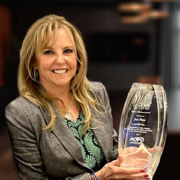
Midwest Transplant Network honored with top awards from Evergen

Midwest Transplant Network honored with top awards from Evergen

Midwest Transplant Network honored with top awards from Evergen

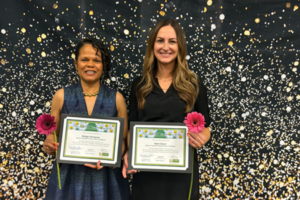
Evergen top awards honor MTN’s Tissue, Quality and Donor Services Departments. 

Midwest Transplant Network has been recognized with three awards from Evergen, formerly RTI Donor Services.

The Evergen Donor Services 2024 Gold Partnership Award was presented based on MTN’s high level of commitment and its significant contribution to healing others through tissue donation.

The Gift of Life Award honors MTN for recovering 49,968 transplantable tissues in 2024. Tissue from a donor hero may include tendons for knee surgeries, skin for burn patients and breast tissue for reconstruction after breast cancer treatment.

The Excellence Award in Osteochondral Performance recognizes MTN’s timely and outstanding work that often benefits younger and active recipients.

“These grafts help recipients regain pain-free mobility,” said MTN Director, Tissue Services, Melissa Williams, CTBS.

Throughout a 16-year partnership, MTN and Evergen continue to have strong connections that heal lives through tissue and eye donation. Annually, Evergen has honored MTN with top awards that recognize the organization for its high standards and lifesaving work for recipients across the world.

“We are honored to receive these awards and have a partnership with Evergen,” said Williams. “We work together to save and enhance countless lives.”

Williams noted the award recognizes the work of three MTN departments including Tissue, Quality and Donor Services.

“We are happy to work with an organization that is pushing the boundaries of innovation and tissue engineering to meet patient needs in regenerative medicine,” said Williams.

Evergen is a leading Contract Development and Manufacturing Organization specializing in biomaterial solutions for regenerative medicine. Evergen creates solutions that are focused on improving patient outcomes through high-quality medical solutions.

Tiffany Nyquist saved Scott Norman's life when she donated her kidney to him.

How Tiffany Nyquist and Scott Norman Celebrate Life and Their Kidney-versary

Tiffany Nyquist saved Scott Norman's life when she donated her kidney to him.

Tiffany saved Scott’s life with her kidney donation. 

 National Donate Life Living Donor Day is April 2. It’s a day dedicated to thanking and honoring living donors and their lifesaving generosity. Tiffany Nyquist is a Midwest Transplant Network Ambassador who shares her story of donating a kidney to her friend Scott Norman. The day we talked to Tiffany and Scott was their 18th kidney-versary.

Scott Norman grew up on a farm in western Kansas. He was a star athlete who lettered in baseball and basketball and could have played college sports. There wasn’t any thought that his strep-infected kidney, diagnosed at age five, would slow him down. It did lead to a kidney transplant from a donor hero when he was 18. He kept living his life.

As a young man from a family of military service members, Scott knew he would continue the family legacy of his father, grandfather and great grandfather. “I signed up for the military and was accepted and approved for the very elite nuclear program at the time, which was the 80s,” he said. “I was looking forward to this new adventure, a new career and earning a college degree while serving.”

Scott completed the academic testing and needed to have a physical at the Naval testing facility. His test results were devastating. The commander told him his urine was spilling protein, and he would lose his kidneys someday. “It could be six months or six years,” the commander said. “We don’t know when this might happen, but unfortunately, we can’t accept you.”

Scott’s dream of serving his country was over. However, his deep faith led him to believe and know this would not be the end of his career success or his future.

A lifesaving friendship

Tiffany Nyquist met Scott through work. They became friends, socializing with their spouses and families. She started babysitting Scott’s three children and grew close to them. Their families spent a lot of time together, even celebrating big holidays.

It was years later when Tiffany watched Scott become sicker with kidney issues. She knew she had to do something to help. “He had been sick for a while and it wasn’t until he was admitted to the hospital that I started thinking about his kids and how close I am with my own dad. I didn’t want to think of his kids not having a father. That’s when I decided to get tested and see if I could be a match for him.”

An early MTN connection

In 2007, Tiffany worked in an office in the same building as Midwest Transplant Network. One day on her lunch break, she went MTN’s reception desk and said, “I know this is going to sound crazy, but I have a friend who’s on the kidney transplant list, and I’d like to see if I could be a match. And I’d like for him not to know it’s me.”

The initial blood work led to more testing. Tiffany was informed she was a match and could donate a kidney to Scott.

It was during a Thanksgiving celebration with the two families that Tiffany told Scott and his wife they were a match, and she wanted him to have her kidney. Scott and his wife were surprised and overwhelmed. And after a few days of praying about it and thinking it over they decided they were ready to move forward.

“I’m a thriver”

After the surgery, Tiffany was in the hospital for three days. After a few weeks, she was back at work and going to the gym. Scott returned to work in three weeks and continued in his leadership role with his company.

Scott said his kidney transplant was a seamless and easy process. “I am a living, walking miracle thanks to Tiffany and Midwest Transplant Network. I’m not just a survivor, I’m a thriver. I’ve been successful in starting a medical device manufacturing company that is saving lives and changing the world of healthcare.”

Tiffany became a registered organ, eye and tissue donor when she got her driver’s license at age 16. “Registering to become a donor when you get your driver’s license is great. I think a lot of people don’t realize the living donation process can be as easy as it was for me. After donating you can live a normal life. I feel like it’s not a huge sacrifice to give somebody 18 or more years of life.”

Tiffany and Scott are both high-energy entrepreneurs running multiple businesses. They don’t spend as much time together as they would like to. However, they do take every opportunity to talk to others about registering to be an organ, eye and tissue donor and share their individual experiences.

They celebrate their kidney-versary every March 6 with a call, text, flowers or lunch. “There’s always some type of acknowledgement,” Scott says beaming with a 1,000-watt smile.